In 2025, Tsinghua Shenzhen International Graduate School (Tsinghua SIGS) celebrated a landmark year of innovation and achievement. The year was defined by notable breakthroughs in academics and research that delivered both impact and inspiration, while further solidifying Tsinghua SIGS as a hub of international talent and collaboration. We also strengthened our collaboration with industry, building pioneering partnerships and delivering real-world solutions to pressing global challenges.
1 Top Scholars including Charles M. Lieber Join Tsinghua SIGS
In 2025, Tsinghua SIGS welcomed four national high-level talents and six academicians, including Charles M. Lieber, a globally renowned researcher in nanoscience and chemistry.
On April 28, Lieber joined Tsinghua SIGS as a full-time faculty member. Charles M. Lieber is a foreign member of the Chinese Academy of Sciences, a member of both the National Academy of Sciences and the National Academy of Medicine in the United States, and a member of the American Academy of Arts and Sciences.
A pioneer in nanomaterials, Lieber has revolutionized the synthesis and application of nanostructures in biomedicine, electronics, and neurotechnology. His breakthroughs in nanowires, nanoelectronics, and biosensors have reshaped computing, photonics, and brain-machine interfaces. His accolades include the Welch Award in Chemistry, the Wolf Prize in Chemistry, and the NIH Director’s Pioneer Award.

2 Five Nature Publications
In 2025, Tsinghua SIGS research teams published a total of 75 papers in Cell, Nature, Science (CNS), and their affiliated journals, including seven in the main journals and five in Nature.
Among the five papers published in Nature, one by Song Qinghua’s team reports advances in topological photonics. Two are contributed by Zheng Bo’s team: the first addresses the growing threat of wildfires, and the second examines how air pollution affects the global methane budget. Additionally, a paper by Kang Feiyu and He Yanbing’s team presents new progress in solid-state lithium metal batteries, while another by Han Sanyang’s team highlights advancements in rare earth electroluminescence.


3 SIGS Faculty Recognized on Global Scientist Lists
Tsinghua SIGS has delivered a strong performance in several prestigious global scientist rankings in 2025.
In the 2025 World's Top 2% Scientists list released by Stanford and Elsevier, 26 SIGS scholars were named in the career-long impact category, and 68 in the annual list. Additionally, Clarivate's 2025 Highly Cited Researchers list features 12 SIGS faculty, marking a 15% year-on-year increase in recognitions.
Academician Zhang Xiaoping has been elected as the Vice President-Education of the IEEE Signal Processing Society for the term 2026-2028. Professors Fu Haohuan and Ercan E. Kuruoglu were elected as 2026 IEEE Fellows for their respective contributions to high-performance computing and signal processing.=

4 Expansion of International Partnerships
In 2025, Tsinghua SIGS established 42 new partnerships. At present, Tsinghua SIGS has established partnerships with 81 global partners across 45 countries and regions, spanning Europe, Asia, the Americas, Oceania, and Africa.
In 2025, Tsinghua SIGS signed cooperation agreements with world-renowned or regionally influential universities, including the Technical University of Munich in Germany, the University of Hong Kong, Lomonosov Moscow State University in Russia, Universitas Indonesia, ADA University in Azerbaijan, Korea University, and the Pontifical Catholic University of Rio de Janeiro in Brazil. These agreements encompass a broad range of areas, including regional offices, joint educational programs, research collaborations, as well as faculty and student exchange.


5 High-Level Academic Events Elevate Global Impact
In 2025, Tsinghua SIGS hosted a series of prestigious international academic conferences, including the 2025 Structural Superlubricity Conference, 2025 AA Visiting School, the International Forum on Graphene in Shenzhen International Conference on 2D Materials, the 2025 AI Competency Training Symposium Across Belt and Road Universities, the 5th Advanced Battery Industry Cluster Forum, the 4th China Marine Engineering Technology Innovation Forum & Launch of the Ocean Journal, and the 2025 International Forum on Advanced Health Engineering.
These events brought together leading global scholars and industry experts to explore cutting-edge technologies and industrial development, providing a vital platform for interdisciplinary exchange, international collaboration, and regional progress.

6 Launch of Phase II Campus Construction
In February 2025, Tsinghua SIGS completed the renovation of its CI and CII teaching buildings, offering upgraded, modernized learning spaces. In the same year, the institute broke ground on its Phase II campus expansion, a project set to increase total floor space by 26.8% and provide essential capacity to advance Tsinghua’s strategic goal of becoming a world-leading university while supporting the school’s 2030 development targets.


7 Launch of Joint Large Model Science and Engineering Program with Tencent
To deepen the Dual Ten Strategy, Tsinghua SIGS expanded its industry partnerships by adding 13 leading enterprises, including Tencent, Mindray, Midea, Sunwoda, and Offshore Oil Engineering Co., Ltd.
In collaboration with Tencent, SIGS launched the “Large Model Science and Engineering” master’s program, recognized as a key scientific and technological achievement of Shenzhen, and announced at the X-Lake Forum.
Key initiatives also included establishing a three-year joint training base with Diandian Interactive, and partnering with Offshore Oil Engineering to integrate talent development into marine technology innovation. Additionally, the “Practice Future Star” Practical Month engaged over 1,500 students through enterprise exchanges and site visits, enhancing industry-academia dialogue.

8 Industry-Academia Collaboration through New Research Center
On November 17, Tsinghua SIGS partnered with Innovation New Material Technology Co., Ltd. to establish the Industrial Embodied Intelligent Robotics Joint Research Center, aiming to develop core technologies and build an integrated innovation ecosystem in smart manufacturing.
Throughout the year, the school delivered multiple collaborative achievements with the industry, including an AI-powered intelligent pathology system developed with Shenzhen People’s Hospital, the completion of the first voyage mission of the UN Ocean Decade Program’s Twilight Zone of West Pacific Ecosystem Research, and a novel technology for efficient food waste conversion and wastewater treatment developed by Associate Professor Lin Lin’s team.

9 Launch of Inaugural Entrepreneurship Competition
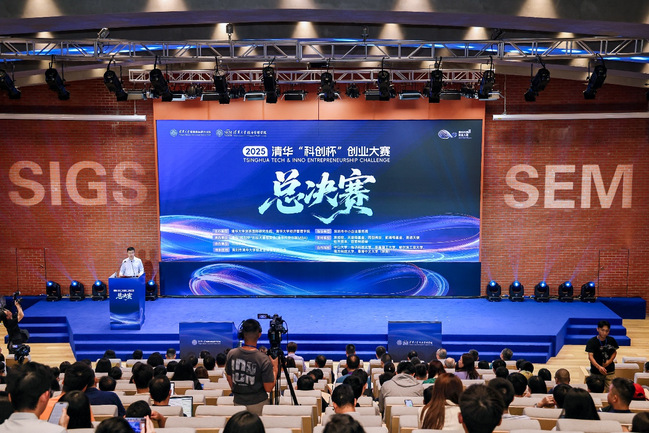
The inaugural Tsinghua Tech & Inno Entrepreneurship Challenge kicked off in May. The competition aims to integrate industry, academia, research, and application, providing a platform to accelerate the transformation of entrepreneurial projects from the lab to the market.
A series of innovation and entrepreneurship activities has further connected higher education research with industrial needs and financial capital, effectively igniting entrepreneurial enthusiasm among students and faculty.
10 International Student Cultivation and Cultural Integration
In 2025, a series of events, including Tsinghua SIGS Global Summer School, the Asia Deep Dive Program of the Asian Universities Alliance (AUA), and TEDxTsinghua SIGS, attracted over 200 international students from more than 50 countries. The events gathered young talents from around the world and allowed more voices from Tsinghua SIGS to be heard.
To broaden students’ international horizons, Tsinghua SIGS supported over 1,600 student exchanges to more than 40 countries and regions, involving 84 universities and institutions. Eight students from Tsinghua SIGS participated in the World Food Forum 2025, organized by the United Nations Food and Agriculture Organization (FAO), contributing their insights on global issues.
In terms of cultural integration, Tsinghua SIGS organized its inaugural International Cultural Carnival in October, which attracted over 400 Chinese and international faculty and students. The event built a platform for cultural exchange and mutual learning between China and the rest of the world.

Edited by Chen Jundou & Wang Jingli
Reviewed by Nie Xiaomei & Lin Zhoulu
Layout by Peng Bin