
He Xiaoming, Professor of the Institute of Biopharmaceutical and Health Engineering at Tsinghua Shenzhen International Graduate School, has been announced as the President-Elect of the Society for Cryobiology for the 2026-2027 term.
Founded in 1964, the Society for Cryobiology brings together those from the biological, medical and physical sciences who have a common interest in the effect of low temperatures on biological systems. The purpose of the Society is to promote scientific research in low temperature biology, to improve scientific understanding in this field, and to disseminate and apply this knowledge.
With the rapid advancement of cell-based medicine offering new hope for patients with refractory diseases, the ability to reliably preserve high-quality stem cells, immune cells, tissues, and organs is essential. Beyond preservation, low-temperature science finds broad applications in areas such as minimally invasive tissue ablation, immunomodulation, aesthetic medicine, analgesia, and creation of biomaterials with surprising properties. The field also holds intrinsic connections to the study of life in extreme environments.
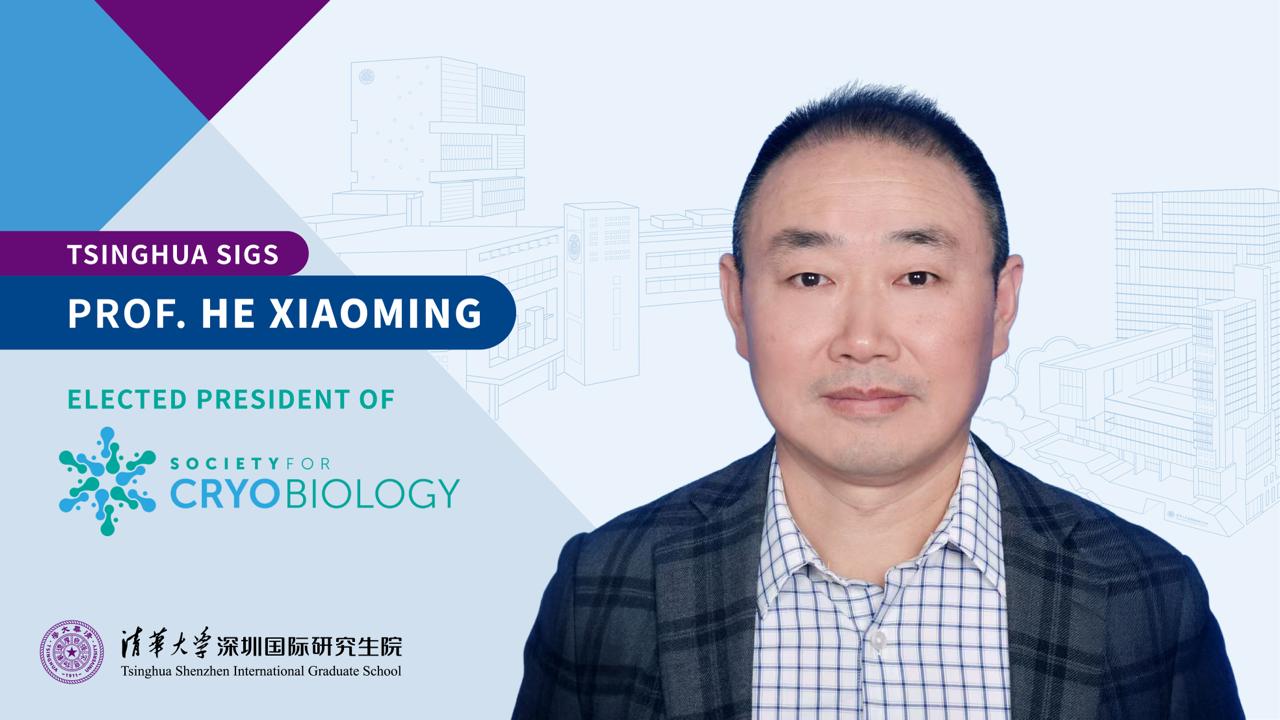
About He Xiaoming
He Xiaoming is a tenured Professor at Tsinghua Shenzhen International Graduate School. He is a member of the European Academy of Sciences and Arts, a Fellow of the American Institute for Medical and Biological Engineering (AIMBE), a Fellow of the American Society of Mechanical Engineers (ASME), and an American Cancer Society (ACS) Research Scholar.
He earned his Ph.D. from the University of Minnesota, USA, in 2004, followed by postdoctoral research at Harvard Medical School-Massachusetts General Hospital. His research primarily focuses on developing micro, nano and quantum-scale, microenvironment-responsive biomaterials and medical devices for stem-cell and immune engineering; banking of biological systems—such as exosomes, cells, tissues, and organs—under both ambient and cryogenic conditions; as well as the intelligent delivery of drugs, genes, and cells in vivo. While working in the United States, his research was supported by multiple major grants from leading funding agencies like the National Institutes of Health (NIH), National Science Foundation (NSF), American Cancer Society (ACS), and Maryland Stem Cell Research Fund, including eight NIH R01 awards. He has published over 150 articles in high-impact journals, such as Nature Biomedical Engineering and Nature Nanotechnology. He served as Vice-Chair (2015–2018) and then Chair (2018–2021) of the ASME Biotransport Technical Committee and is currently the Editor-in-Chief of the Journal of Medical Devices, published by ASME.
Source from the Institute of Biopharmaceutical and Health Engineering
Edited by Chen Jundou
Reviewed by Nie Xiaomei and Lin Zhoulu