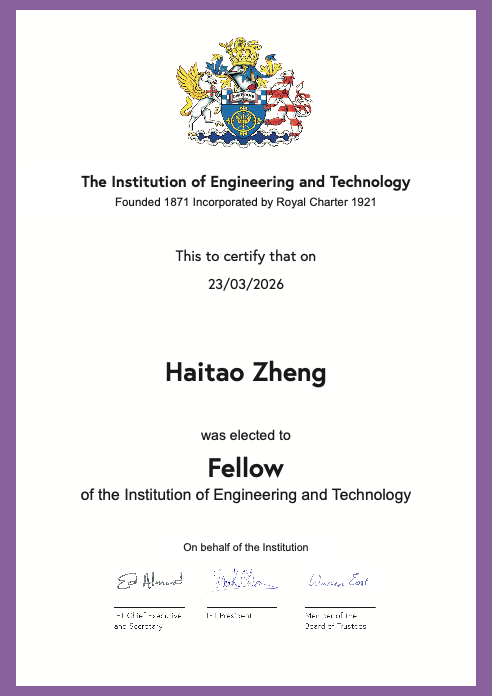
In March 2026, Associate Professor Zheng Haitao of Tsinghua Shenzhen International Graduate School (Tsinghua SIGS) was elected a Fellow of the Institution of Engineering and Technology (IET). A month later, he was named an RSA Life Fellow by the Royal Society of Arts (RSA), in recognition of his outstanding academic contributions and industrial achievements in artificial intelligence, knowledge engineering, and large language models.
IET is one of the world’s leading professional societies for engineering and technology, with a history spanning over 150 years. With over 170,000 members across 150 countries and regions, it is the second-largest professional society in the world and the largest in Europe.
The IET Fellow is the institution's highest honor, granted to leading experts who have demonstrated sustained excellence in leadership, innovation, and significant societal contributions in engineering and related fields. Each year, only about 200 individuals worldwide are elected as IET Fellows through a rigorous selection process.
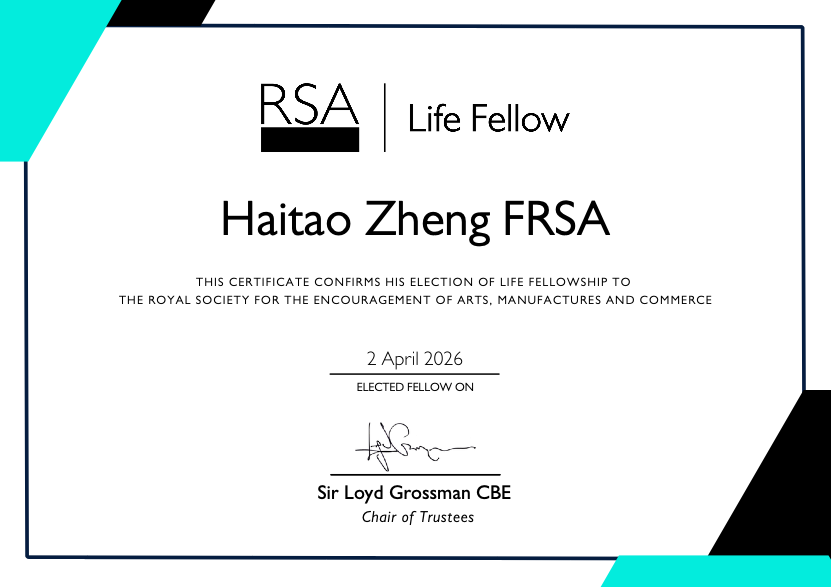
Founded in 1754 and headquartered in London, the RSA is an academic institution spanning the humanities, arts, natural sciences, industry, manufacturing, commerce, and many other fields.
The RSA distinguishes between two categories of members: Fellows and Life Fellows. Candidates for Life Fellowship must follow the established procedures set out in the Royal Charter, involving recommendation, nomination, election, and final approval by the review committee before they can become Life Fellows. Upon election, they are awarded the title Life FRSA (full title: Life Fellow of the Royal Society of Arts), which represents the highest academic honor bestowed by the RSA on an individual.
Over its more than 270 years of history, the RSA’s Life Fellows have included academic leaders from over 80 countries worldwide.
About Zheng Haitao
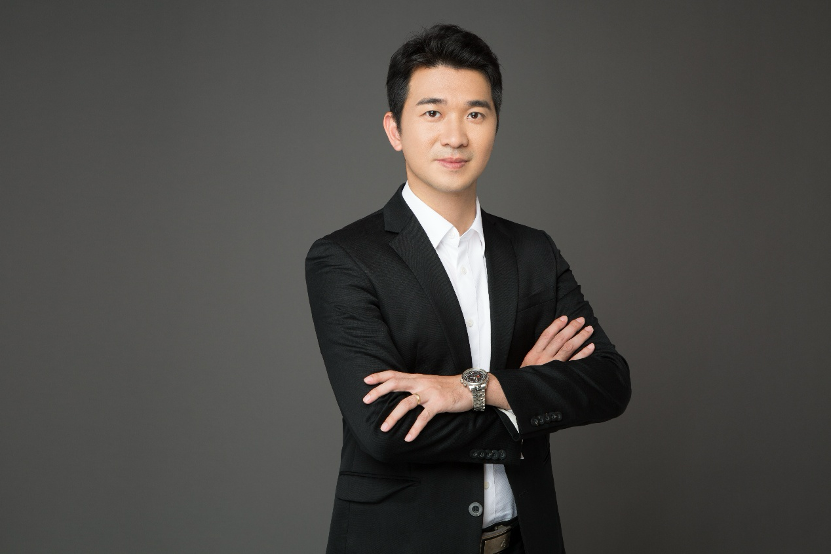
Zheng Haitao is an Associate Professor and Doctoral Supervisor at the Institute of Data and Information, Tsinghua Shenzhen International Graduate School. He also serves as Deputy Director of the Institute of Artificial Intelligence Science and Technology, Deputy Director of the Knowledge Engineering Research Center, Deputy Director of the Shenzhen Engineering Laboratory for Intelligent Semantic Mining Technology, and a Member of the Language and Knowledge Computing Special Committee of the Chinese Information Processing Society of China.
He has long been engaged in research in the fields of artificial intelligence, knowledge engineering, and large language models. He proposed the lightweight convolutional neural networkShuffleNet V2, widely recognized as a landmark achievement of lightweight convolutional neural networks. He developed OpenPrompt, a general programming framework for prompt learning, which won the Best System Demonstration Paper Award at ACL 2022. He put forward Delta Tuning, a parameter-efficient adaptation framework for large models; the research results were published as a cover paper in Nature Machine Intelligence (Impact Factor: 23.9), selected as an ESI Highly Cited Paper, and won many important honors including the Outstanding Young Paper Award at the World Artificial Intelligence Conference and the Best Academic Paper Award at the China Computing Power Conference.
Zheng’s team has made continuous breakthroughs in large model agents, multimodal understanding and generation, trustworthy artificial intelligence and other directions. Relevant results have been published in top international conferences and journals such as NeurIPS, ICLR, ICML, ACL, CVPR, KDD, NMI, and TKDE. He has published more than 200 academic papers in total, holds over 20 authorized invention patents, and has accumulated more than 17,000 citations on Google Scholar. Meanwhile, he has maintained long-term and in-depth industry-university-research cooperation with Huawei and Tencent, delivered many industrial applications relying on the Rhino-Bird Special Research Program, and won the Tencent Rhino-Bird Technical Innovation Award and Outstanding Mentor Award. His research results were selected as an Outstanding Case in the Industry-University Cooperation and Collaborative Education Program jointly launched by the Ministry of Education and Tencent.
Source from the Institute of Data and Information
Edited by Chen Jundou
Reviewed by Lin Zhoulu and Nie Xiaomei
Layout by Peng Bin and Yuan Yiling