Harmful algal blooms frequently arise from eutrophication in waterbodies,posing severe threats to aquaticecosystems and drinking water safety. However, these blooms sometimes terminate abruptly, involving massive cell lysis within only a few days.
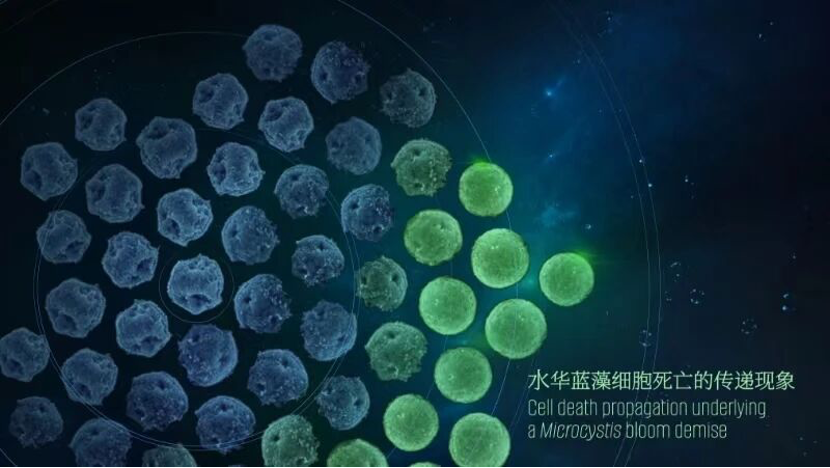
Focusing on this topic, a research team from Tsinghua Shenzhen International Graduate School (Tsinghua SIGS) led by Associate Professors Tao Yi and Wang Xiaoxiong, together with Professor Hu Hongying from the School of Environment, Tsinghua University, set outto uncover the natural secret behind the coordination of collective cell death underlying synchronized bloom termination.
Their latest findings, titled Iron-catalyzed active lipid peroxides drive ultrafast collective cell death in blooming algae, were published in Science on June 25 (local time).
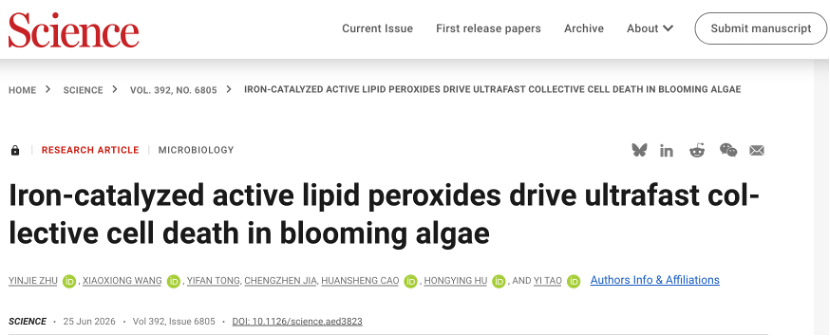
What is behind ultrafast collective cell death in blooming algae
Harmful algal blooms are severe global ecological hazards, yet few effective targeted strategies are availableto control their outbreaks. These blooms often terminate abruptly, involving massive cell lysis within only a few days. Such large-scale collective cell death necessarily requires the rapid execution of individual cell death and its propagation across the entire population. Elucidating the coordination of collective cell death underlying bloom termination may help inform effective bloom control.
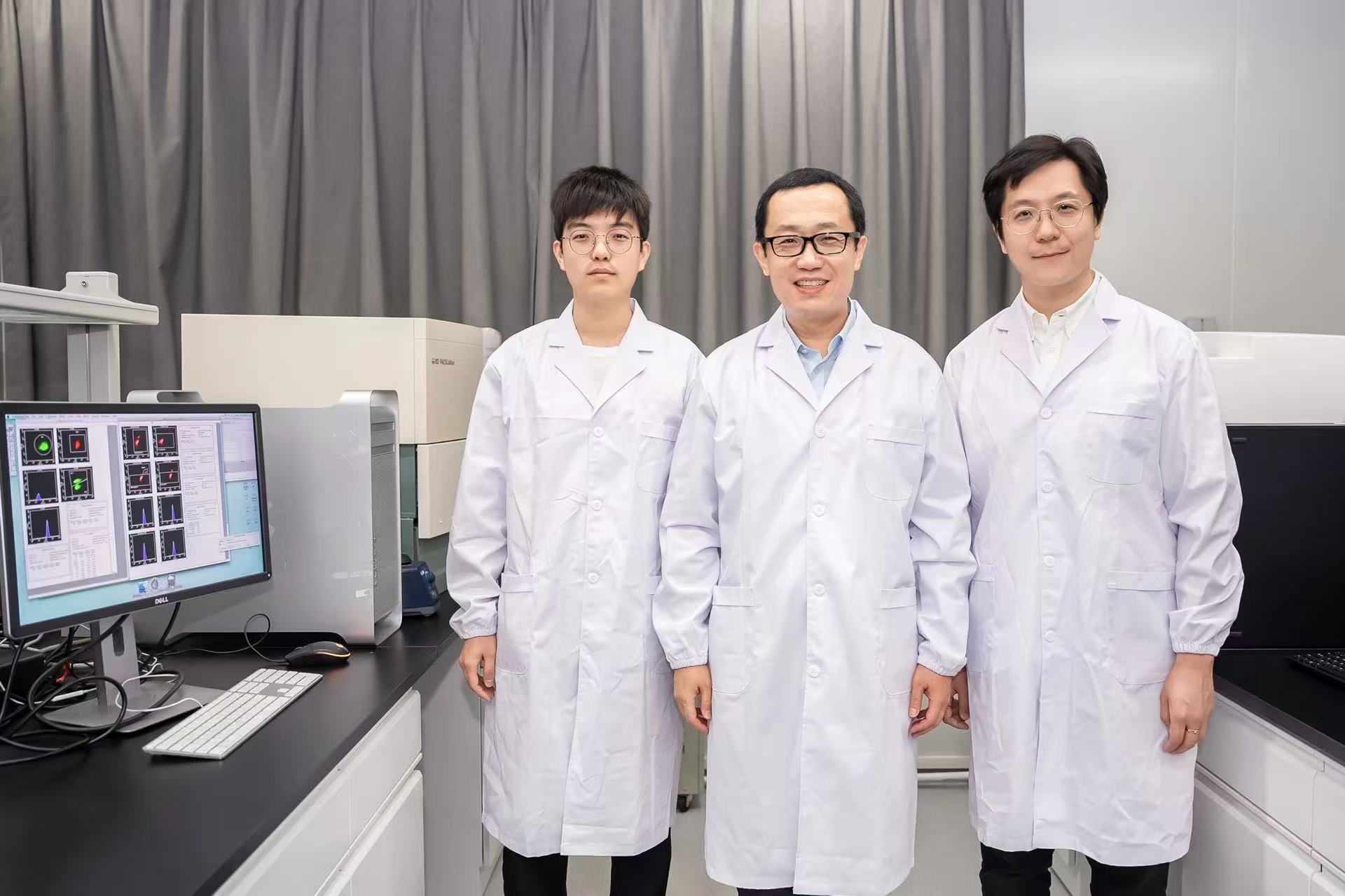
First author Zhu Yinjie and corresponding authors Tao Yi and Wang Xiaoxiong (from L to R). Photo by Huang Yinsi
The study originated from a key observation made in 2021 by the paper's first author, Zhu Yinjie, who was then a master's student and is currently a doctoral student at Tsinghua SIGS.While conducting experiments, Zhu found that once the level of labile iron inside cyanobacterial cells exceeded a critical threshold, damage to the cell membranes intensified and cells died much more rapidly than expected.
The researchers hypothesize that abundant iron in cyanobacterial cells catalyzes lipid peroxidation chain reactions, coordinating collective cell death in bloom populations. The researchers investigated the involvement of iron-catalyzed lipid peroxidation in a Microcystis bloom demise event by monitoring temporal changes in cellular labile iron and lipid peroxide levels and simulating spatial distribution of deaths within colonies.
The researchers experimentally intensified iron-catalyzed lipid peroxidation to probe how individual cell death is executed and propagated among Microcystis populations.
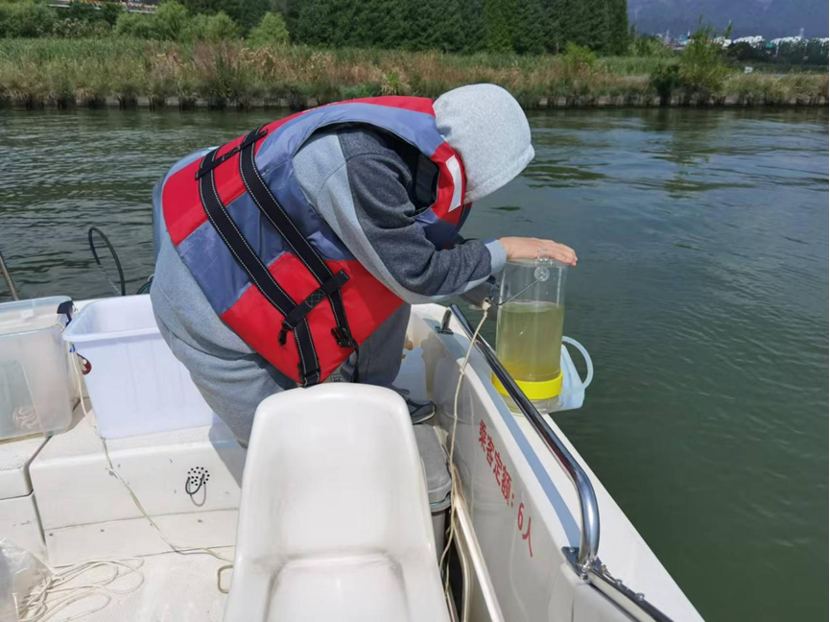
A research team member collects samples at Dianchi Lake in Kunming, southwest China’s Yunnan Province.
During the rapid demise of a natural Microcystis bloom, cellular labile iron overload, oxidative stress, lipid peroxidation, plasma membrane permeabilization, and cell lysis occurred sequentially. These single-cell physiological alterations culminated in a nonrandom spatial distribution pattern of cell deaths within Microcystis colonies.
Upon induction of iron-catalyzed lipid peroxidation in blooming Microcystis cells, accumulated labile iron promoted truncation of phospholipids, generating phospholipids with shortened acyl chains bearing terminal alkyl groups. These active peroxides destabilized plasma membranes, perforated membranes with the formation of nanoscale pores, and ultimately executed ferroptosis and cell lysis in individual cells. Truncated lipid species were released from dying cells in both micellar and free-molecule forms and propagated lipid peroxidation to neighboring cells, amplified plasma membrane destabilization, and eventually led to the emergence of collective cell death in Microcystis populations.
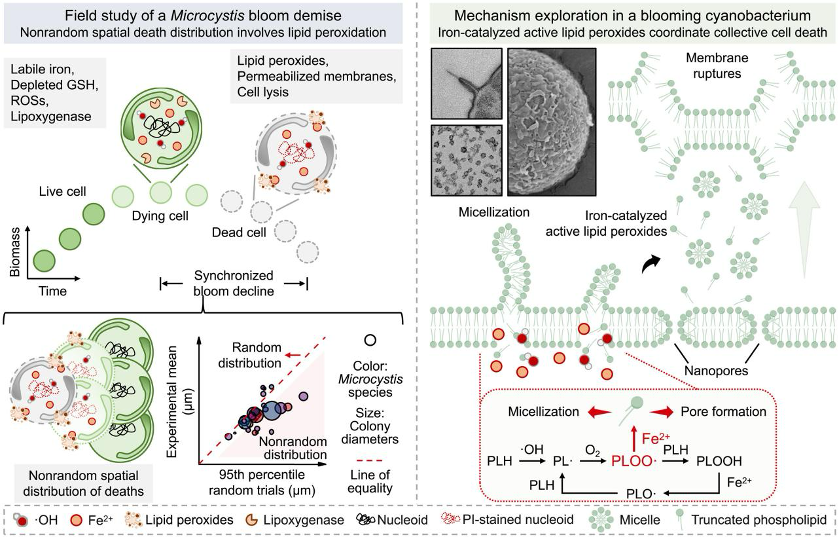
Emergence of large-scale cell death in blooming cyanobacteria driven by iron-catalyzed lipid peroxidation.
Iron-catalyzed lipid peroxidation executes ferroptosis in individualcyanobacterial cells, which propagates to neighboring cells, thereby precipitating population collapses. Truncated phospholipids bearing terminal alkyl groups act as both the executor and propagator of ferroptosis.
Given that the observed nonrandom spatial distribution of cell deaths within Microcystis colonies correlates with iron overload and lipid peroxidation during the bloom demise, these findings highlight ferroptosis as critical in coordinating bloom declines and suggest a potential mechanism for controlling bloom outbreaks by regulating active lipid peroxides to actively drive collective cell death.
Breakthrough through interdisciplinarity
According to Tao Yi, the greatest breakthrough of this study stemmed from interdisciplinary collaboration.
Tao has long focused on the principles and technologies to control harmful algal blooms and to reduce pollution and carbon emissions through algae–bacteria interactions.
Wang Xiaoxiong, whose research centers on electrofiltration for decentralized water treatment, contributed application-oriented insights from catalytic and engineeringperspectives. The two researchers have maintained a collaborative partnership for over a decade.
Throughout the project, Professor Hu Hongyingguided conceptual design and research ideas, while Cao Huansheng, Assistant Professor at Duke Kunshan University, enriched the study through bioinformatics analyses.
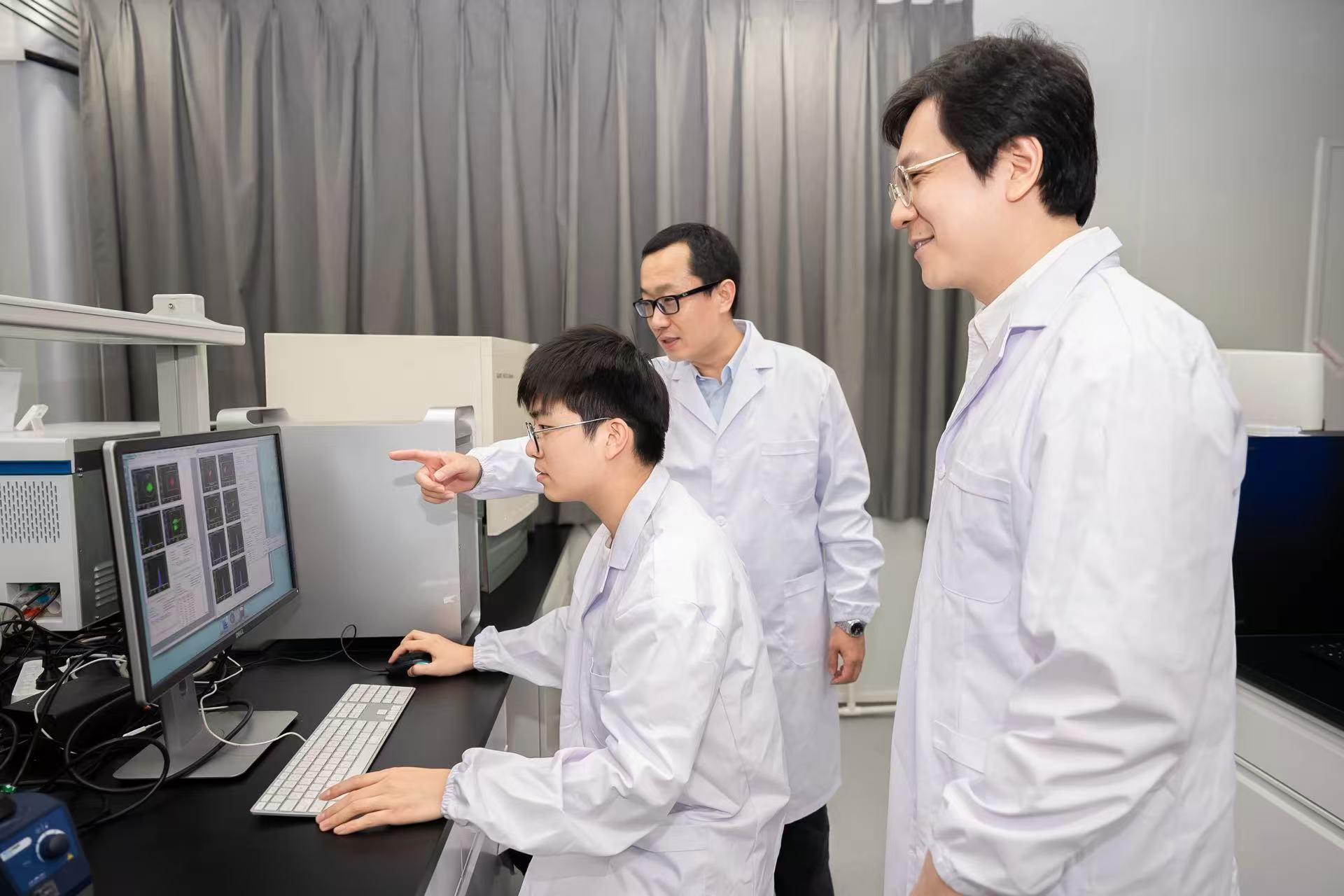
The research team discusses experimental data.
The interdisciplinary nature of the project extended beyond collaboration between researchers to thorough integration of research platforms and scientific methods. By leveraging open and shared research facilities at Tsinghua SIGS, the team combined advanced technologies, including flow cytometry, label-free live-cell microscopy, and electron microscopy, to address cross-disciplinary technical barriers across ecology, environmental science, biology, and physics.
For Zhu Yinjie, this project was less a formal assignment than an immersive process of learning, experimentation, and iterative refinement. Throughout this journey, he kept returning to the guiding principles that Tao and Wang had impressed upon him: “Do not be discouraged by slow progress. Dare to pursue truly original work—research that moves ideas from conception to reality. Most importantly, our research should always begin with real-world problems.”
The study received high praise from all three Science reviewers, who regarded the discovery as highly significant to the algal research field. They also commended the originality of the team's researchmethodology and encouraged further explorationinspired by these findings.
The research team is currently advancing translational researchto convert these fundamental discoveries into deployable engineering solutions. Their goal is to enable timely intervention in the early stages of harmful algal blooms and to translate bloom control strategies from lab-scale to real-world practice. Through theseongoing efforts, the team hopes to contribute innovative solutions for protecting aquatic ecosystems and advancing sustainable water management.
Full article: https://www.science.org/doi/10.1126/science.aed3823
Source from Science, Tsinghua SIGS
Edited by Wang Jingli
Reviewed by Chen Junduo, Lin Zhoulu
Layout by Peng Bin, Yuan Yiling