On July 19, the Tsinghua Shenzhen Design Praxis Forum was held in the C2 Lecture Hall at Tsinghua Shenzhen International Graduate School (Tsinghua SIGS). Jointly organised by the Institute of Future Human Habitats (iFHHs) at Tsinghua SIGS and the Architectural Association School of Architecture (AA), and hosted by the Tsinghua SIGS iFHHs Digital Engine Laboratory (TiDE Lab), the forum sought to establish an interdisciplinary and cross-cultural platform for academic dialogue and to advance deeper integration across architecture, computational science, design, game development, and intelligent manufacturing.
The forum brought together distinguished scholars and industry leaders from more than ten countries, alongside participants in the 2026 AA–THU Visiting School. Leading contributors included Zhuang Weimin, Member of the Chinese Academy of Engineering; Brett Steele, Dean of the USC School of Architecture; Lou Yongqi, President of Shanghai University of Engineering Science; and Shen Zhenjiang, Foreign Member of the Engineering Academy of Japan. Each delivered a keynote address and took part in round-table discussions, offering insights into future paradigms of human habitation, digital construction, and interdisciplinary innovation.
At the opening ceremony, Professor Liu Bilu, Vice Dean of Tsinghua SIGS, and Associate Professor Huang Jianxiang, Vice Dean of the Institute of Future Human Habitats, delivered welcome remarks. They affirmed the forum’s academic vision and its significance for international collaboration, encouraging participants to take design praxis as a point of departure for translating frontier theories into tangible forms of social and technological transformation. The forum was co-moderated by Associate Professor Guo Mengdi and Assistant Professor Zhou Zhenru, both doctoral supervisors at the Institute of Future Human Habitats, Tsinghua SIGS.
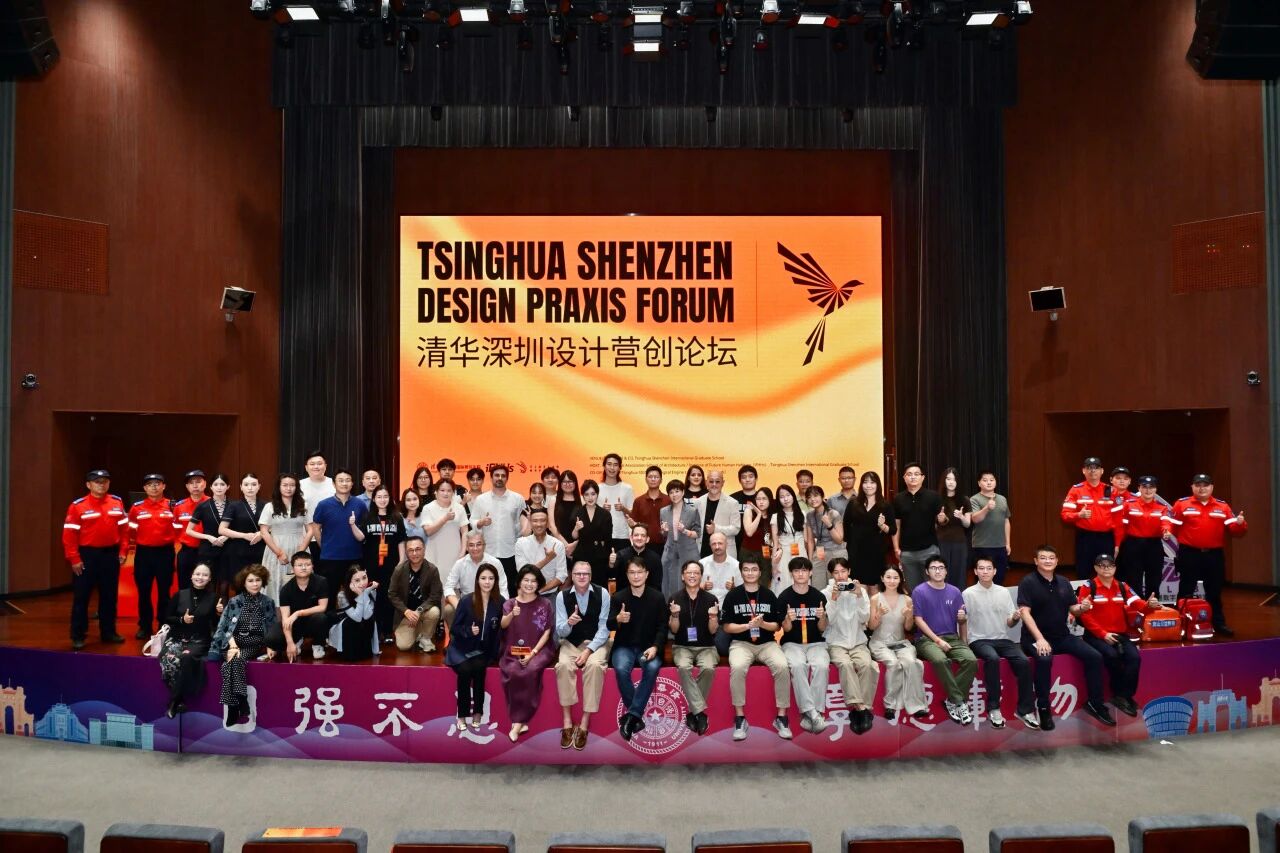
Event Group Photo
During the forum, the Tsinghua SIGS iFHHs Digital Engine Laboratory (TiDE Lab) was formally inaugurated. The unveiling was conducted jointly by Professor Zhuang Weimin, Member of the Chinese Academy of Engineering; Associate Professor Huang Jianxiang, Vice Dean of the Institute of Future Human Habitats; Professor Gao Yan, Director of TiDE Lab; and Jiang Yuxi, Founder and Deputy Director of TiDE Lab. Based at Tsinghua SIGS, TiDE Lab focuses on two principal areas: the independent research and development of foundational digital-engine technologies, and their application in industry. It incorporates two practice-based platforms—the iDEA Design Studio and ZAO Society—and is committed to establishing an internationally leading platform for innovation and integration in digital-engine technologies, while enabling their systematic implementation in everyday contexts. The establishment of the laboratory marks an important step forward in the Institute’s interdisciplinary collaboration and in the translation of academic research into industrial practice.
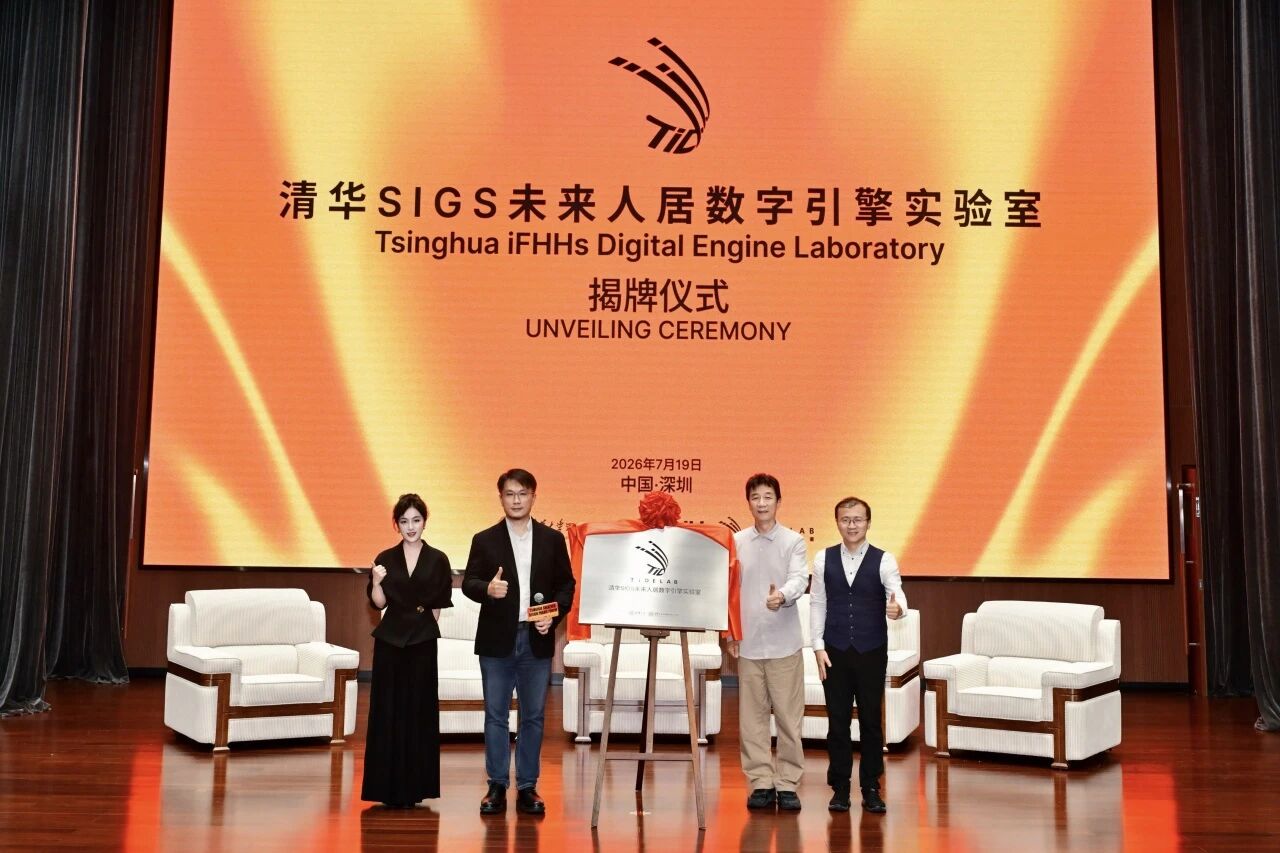
Unveiling Ceremony
The first panel was moderated by Associate Professor Gao Yan of Tsinghua SIGS, Director of TiDE Lab. Keynote addresses were delivered by Brett Steele, Dean of the USC School of Architecture, and Lou Yongqi, President of Shanghai University of Engineering Science. Zhuang Weimin, Member of the Chinese Academy of Engineering and Professor at Tsinghua University, and Zhu Jingxiang, Associate Professor at the School of Architecture, The Chinese University of Hong Kong, joined the subsequent discussion.
The speakers examined several fundamental questions confronting architecture in the age of artificial intelligence, including the nature of design education, AI’s reshaping of disciplinary boundaries, interdisciplinary models of teaching and research, and AI-enabled forms of Deep Design practice. A shared conclusion emerged: design education must cultivate both a profound awareness of design and an expansive capacity to frame problems if students are to respond critically to the cognitive challenges generated by technological change.
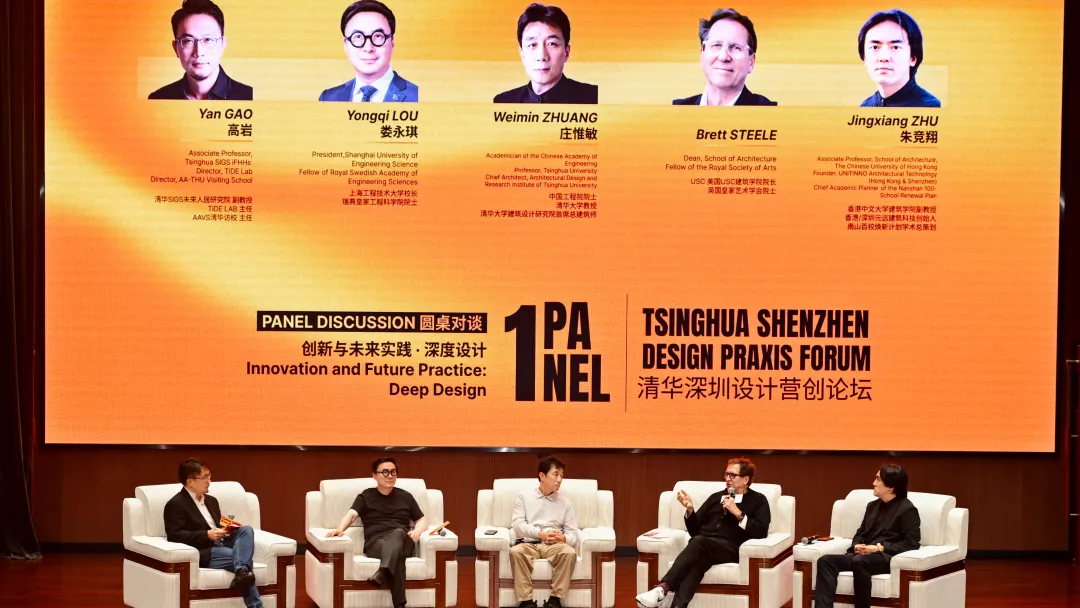
Special Report On-site
The second panel was moderated by Associate Professor Huang Jianxiang, Vice Dean of the Institute of Future Human Habitats. Keynote addresses were delivered by Professor Xu Weiguo of Tsinghua SIGS and Shen Zhenjiang, Foreign Member of the Engineering Academy of Japan and Dean of the School of Architecture at Fuzhou University. Zhai Yongping, Senior Adviser in Tencent’s Strategy Development Department, and Liu Shaoyu, Distinguished Professor at Macau University of Science and Technology, joined the discussion. The panel focused on emerging directions in AI-enabled construction, intelligent building, the integration of carbon-neutral strategies, and low-carbon operation and maintenance. Participants argued that the co-evolution of AI and low-carbon technologies is fundamentally reshaping the construction industry and providing systemic support for the high-quality development of future human habitats.
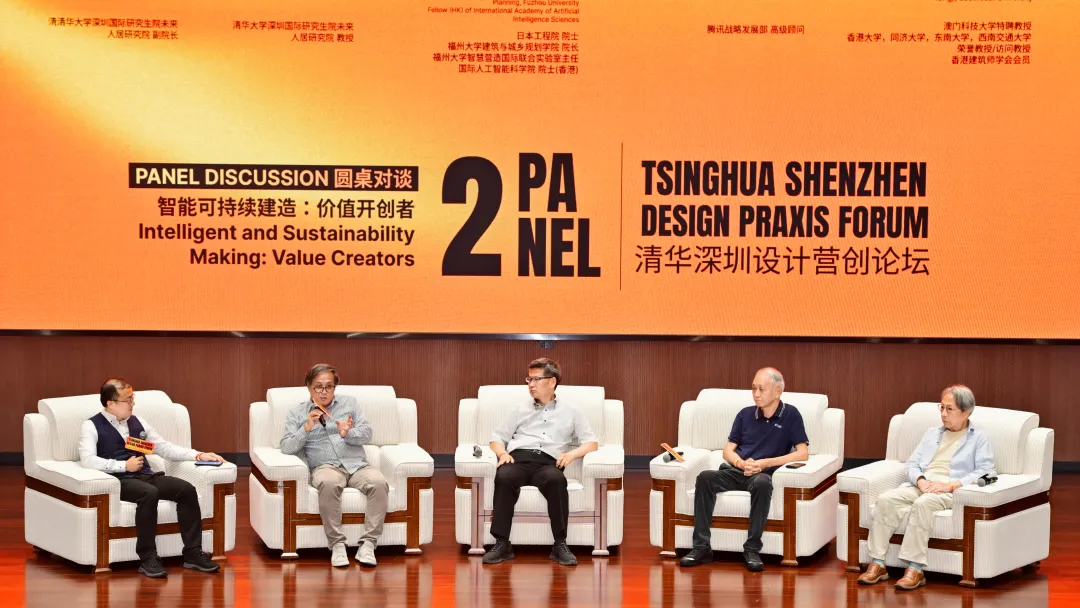
Special Report On-site
The third panel was moderated by Xu Zonghan, Dean of the School of Design at Shanghai University of Engineering Science. Speakers included Richard Wood, Managing Director for Asia at Snøhetta; Ruan Wentao, Founder of GROUNDWORK; Liao Jiawei, Head of Customer Ecosystem at Henderson Land Development; and Zheng Yingyi, Chief Design Officer at China Resources Mixc Lifestyle. Drawing on perspectives ranging from cross-cultural practice and emotional connection to community experience and multisensory engagement, the panel explored the deeper relationship between people and space. The speakers argued that the essence of design lies in creating resonance between human experience and spatial environments. Visual, auditory, tactile, and other sensory dimensions should therefore be brought together so that design moves beyond the production of form towards the cultivation of profound experience.
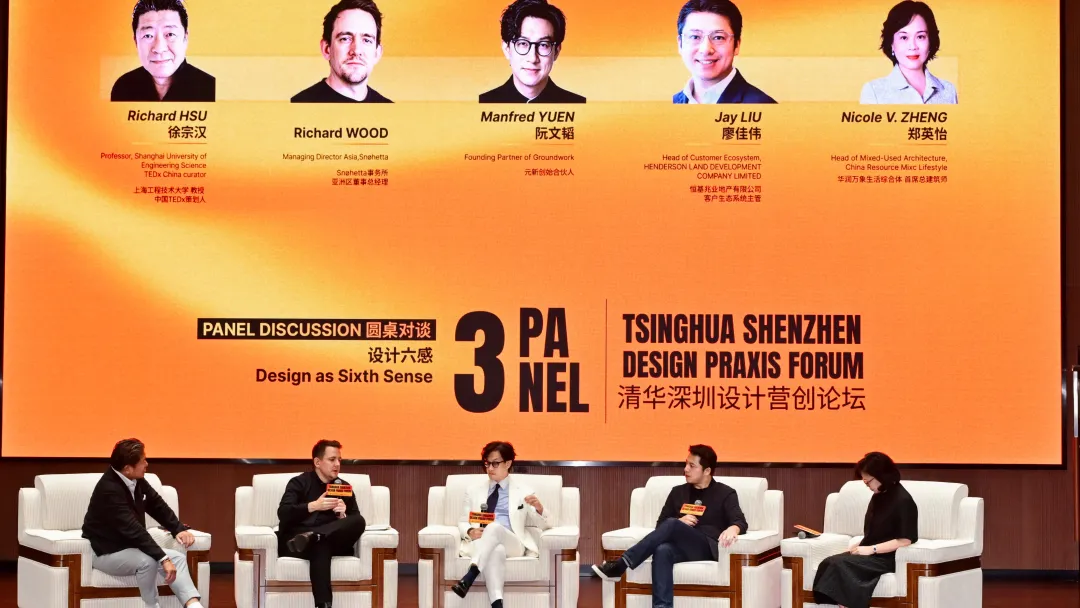
Special Report On-site
The fourth panel, entitled “Design for Future Entertainment: The Science of Play,” was moderated by Jiang Yuxi, Founder and Deputy Director of TiDE Lab. Keynote addresses were delivered by Bryant Lu, Justice of the Peace; David Hiebaum, Founder of Moyo Creative; and Manny Ling, Associate Dean of the School of Communication and Design at RMIT University Vietnam. Chai Zhikun, Chairman of Tianhong Group, joined the discussion. The panel examined three interrelated questions: the displacement of creative agency, the reconfiguration of experiential logic, and the reversal of human–machine relations. Its central proposition was that future entertainment must continually ask what constitutes an authentic experience and how human beings position themselves within it. In this sense, play is evolving from a form of leisure into a new mode of practice with direct implications for the future of human habitation.
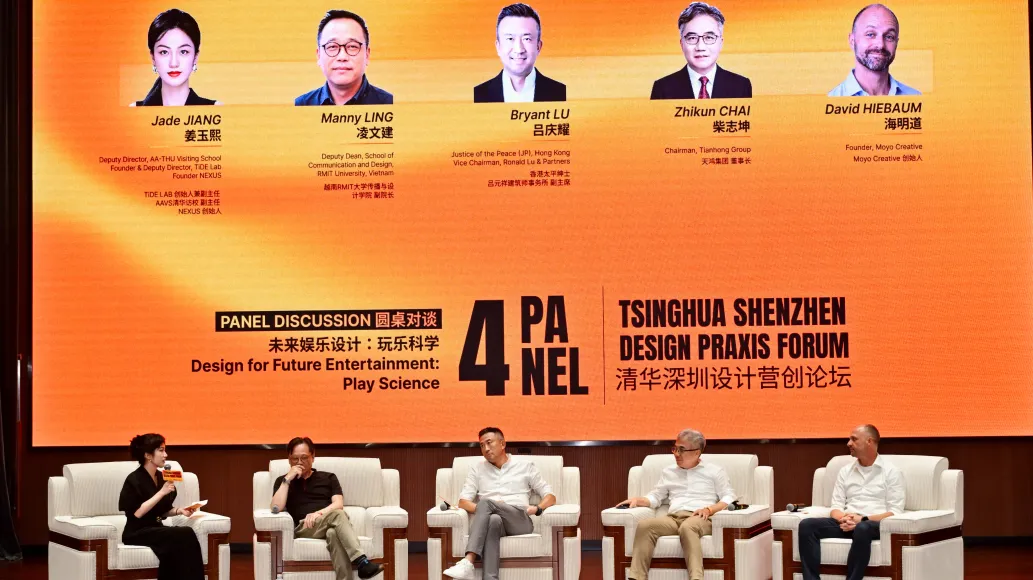
Special Report On-site
In his closing remarks, Associate Professor Gao Yan, Director of TiDE Lab, expressed his sincere gratitude to all guests, participants, and staff. He reiterated the forum’s central conviction: in an era of profound technological transformation, the role of design is not merely to follow technology, but to give it direction and value. Situated within the Guangdong–Hong Kong–Macao Greater Bay Area, one of the world’s foremost centres of innovation, the forum took Deep Design as its conceptual anchor and advocated a collaborative paradigm in which practice drives thought and thought empowers technology.
Through this paradigm, design can become a creative nexus connecting disciplines, industry, and human well-being. The forum was not only a gathering of ideas, but also a collective inquiry into the ontology of design itself. The interdisciplinary dialogue and shared commitment it generated will continue to invigorate academic research, industrial transformation, and social innovation, while offering practice-based insights from China’s Greater Bay Area to the global design community as it confronts the complex challenges posed by artificial intelligence and the future of human habitats. The forum concluded in an atmosphere of shared purpose and forward-looking optimism.
Source from the Institute of Future Human Habitats
Reviewed by Chen Jundou, Lin Zhoulu, and Nie Xiaomei
Layout by Peng Bin and Cao Zhiruo